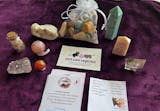
Best Grounding Crystals for Winter: 13 Crystals for Stability, Protection & Reflection
![]() Best Grounding Crystals for Winter
Best Grounding Crystals for Winter
In Australia, winter brings shorter days, cooler temperatures and a shift towards slower routines. Many people spend more time indoors, creating spaces that feel comfortable, calm and restorative.
Grounding crystals are often associated with this season because they are linked to stability, protection, focus and reflection. Whether you are interested in crystals for their metaphysical associations, enjoy collecting minerals, or simply appreciate the geological history contained within them, winter is an ideal time to explore these stones.
Many crystals associated with grounding are also among the oldest materials found within the Earth's crust. Formed under immense pressure, heat, and geological change over millions of years, they provide a tangible connection to the natural world.
What Are Grounding Crystals?
The term "grounding" is commonly used to describe a feeling of stability, presence and connection to the physical world.
While scientific evidence for crystal-specific effects remains limited, sensory objects and mindful rituals have been widely studied for their ability to support present-moment awareness. Holding a stone, observing its texture, or incorporating it into a daily routine can become a simple grounding practice.
Many grounding crystals share similar characteristics. They are often darker in colour, more opaque, and contain iron-rich minerals formed deep within the earth.

Black Tourmaline
Black Tourmaline, also known as schorl, is one of the most widely recognised grounding and protection stones.
From a geological perspective, it is piezoelectric - meaning it can generate an electrical charge when subjected to pressure. Tourmaline commonly forms within pegmatites and hydrothermal environments, often alongside quartz and feldspar.
Many people associate Black Tourmaline with protection, boundaries and stability.
Smoky Quartz
Smoky Quartz develops its characteristic grey to brown colour through natural irradiation occurring within the earth over long periods of time.
It is one of the most popular grounding stones due to its association with calm, stability, and balance. High-quality specimens can have excellent clarity alongside rich earthy tones.
Red Jasper
Red Jasper is coloured by iron oxide, the same mineral responsible for the red hues seen in many Australian landscapes.
It is commonly associated with endurance, resilience and steady energy. Red Jasper is a dense variety of microcrystalline quartz that has been used by cultures around the world for thousands of years.
Obsidian
Unlike most crystals, Obsidian is not technically a mineral.
It forms when volcanic lava cools so rapidly that atoms do not have time to organise into a crystalline structure. The result is natural volcanic glass with a smooth, reflective surface.
Obsidian is often associated with clarity, self-reflection and personal insight.
Tiger's Eye
Tiger's Eye is known for its golden chatoyancy, often called the "cat's eye" effect.
The stone forms through a geological process known as pseudomorphism, where quartz gradually replaces fibrous crocidolite while preserving its original structure. This creates the silky bands of light seen across the surface.
Tiger's Eye is commonly associated with confidence, focus and action.
Garnet
Garnet is a group of closely related silicate minerals found in metamorphic and igneous rocks around the world.
Deep red varieties are among the most recognisable and have been used in jewellery for centuries. Garnets commonly form under conditions of high pressure and temperature and are often associated with vitality, passion and determination.

Moonstone
Moonstone belongs to the feldspar family and displays a phenomenon known as adularescence, where light appears to glow beneath the surface of the stone.
It is commonly associated with reflection, balance and new beginnings.
Aquamarine
Aquamarine is a blue variety of beryl valued for its clarity and well-defined hexagonal crystal structure.
It forms within granitic pegmatites and has long been appreciated by both mineral collectors and jewellers. Aquamarine is commonly associated with calm communication, clarity and emotional balance.
Labradorite
Labradorite is a feldspar mineral known for its flashes of blue, green, gold and copper.
This optical effect, known as labradorescence, occurs when light interacts with microscopic layers within the stone. Labradorite is often associated with transformation, intuition and personal growth.
Garden Quartz
Garden Quartz contains mineral inclusions that became trapped during crystal growth, creating unique internal landscapes within the quartz.
No two specimens are identical, making it a favourite among collectors. Garden Quartz is often associated with grounding, growth and connection to nature.
Clear Quartz
Clear Quartz is one of the most abundant and recognisable minerals on Earth.
It forms under a wide range of geological conditions and has been collected and used throughout human history. Clear Quartz is commonly associated with clarity, focus and amplification.
Celestite
Celestite is recognised for its pale blue colour and delicate crystal formations.
The mineral forms within sedimentary environments and is often found as sparkling crystal clusters. Celestite is commonly associated with calm, peace and quiet reflection.
Vera Cruz Amethyst
Vera Cruz Amethyst is known for its exceptional clarity and lighter lilac colouring compared with many other amethyst localities.
The crystals are typically slender and highly transparent. Collectors value Vera Cruz Amethyst for its distinctive crystal habit and limited locality. It is often associated with clarity, intuition and reflection.
Ways to Use Grounding Crystals During Winter
Winter often encourages slower and more intentional routines.
Some people keep a favourite crystal on their desk while working. Others place a specimen on a bedside table or use a stone during quiet moments of reflection. There is no right or wrong approach. Many people simply enjoy having minerals nearby because of their appearance, texture and geological significance.
Caring for Crystals During Winter
A few simple considerations can help protect crystal specimens during colder months:
- Use moonlight rather than direct sunlight for display pieces that may be sensitive to fading.
- Sound cleansing methods such as singing bowls or tuning forks can be used indoors year-round.
- Selenite charging plates are often used as a convenient storage option for smaller crystals.
- Avoid exposing specimens to sudden temperature changes, particularly crystals containing fractures, water inclusions or delicate formations.
- Keep delicate clusters away from condensation that may form near windows during colder weather.
Frequently Asked Questions
What is the best grounding crystal?
Black Tourmaline and Smoky Quartz are among the most commonly recommended grounding crystals due to their associations with stability, protection and calm.
Which crystals are popular during winter?
Black Tourmaline, Smoky Quartz, Garnet, Red Jasper, Labradorite, Moonstone, Aquamarine, Celestite, Garden Quartz, and Clear Quartz are all popular choices during winter.
Can grounding crystals be used as home decor?
Yes. Many people enjoy mineral specimens purely for their natural colours, crystal formations, and geological history. Crystals can be displayed on shelves, desks, coffee tables or within collector cabinets.
Overall...Many of the crystals associated with grounding share a common geological story. They formed deep within the earth through pressure, heat, volcanic activity or slow mineral growth over millions of years.
Whether you collect minerals for their beauty, scientific interest or personal meaning, winter is a great time to appreciate these amazing natural formations and the geological processes that created them.